
Why 95% of AI Projects Fail: AI Is an Operating Model, Not a Bolt-On
8 min read time

GRM Digital

Businesses have spent an estimated $30–40 billion on generative AI. According to MIT, 95% of organisations have nothing to show for it.
That is the headline finding of The GenAI Divide: State of AI in Business 2025, a study by MIT's Project NANDA. Only 5% of integrated AI pilots are extracting millions in value. The rest have no measurable impact on profit and loss.
The researchers were clear about what separates the two groups. It is not the quality of the AI model, and it is not regulation. It is the approach.
That should change how every leadership team thinks about AI implementation. The organisations getting real returns are not the ones with the most tools. They are the ones that treat AI as a new way of operating, rather than a feature bolted onto the way they already work.
In this article, we look at what MIT found, why most AI projects stall, and what it takes to join the 5%.
What MIT actually found
The MIT study drew on a review of more than 300 public AI initiatives, interviews with 52 organisations and a survey of 153 senior leaders. Its picture of AI adoption is one of high activity and low transformation.
Adoption is everywhere. Over 80% of organisations have explored or piloted tools such as ChatGPT and Copilot, and nearly 40% have deployed them. But MIT found these tools mainly boost individual productivity. They rarely move the numbers that matter to the board.
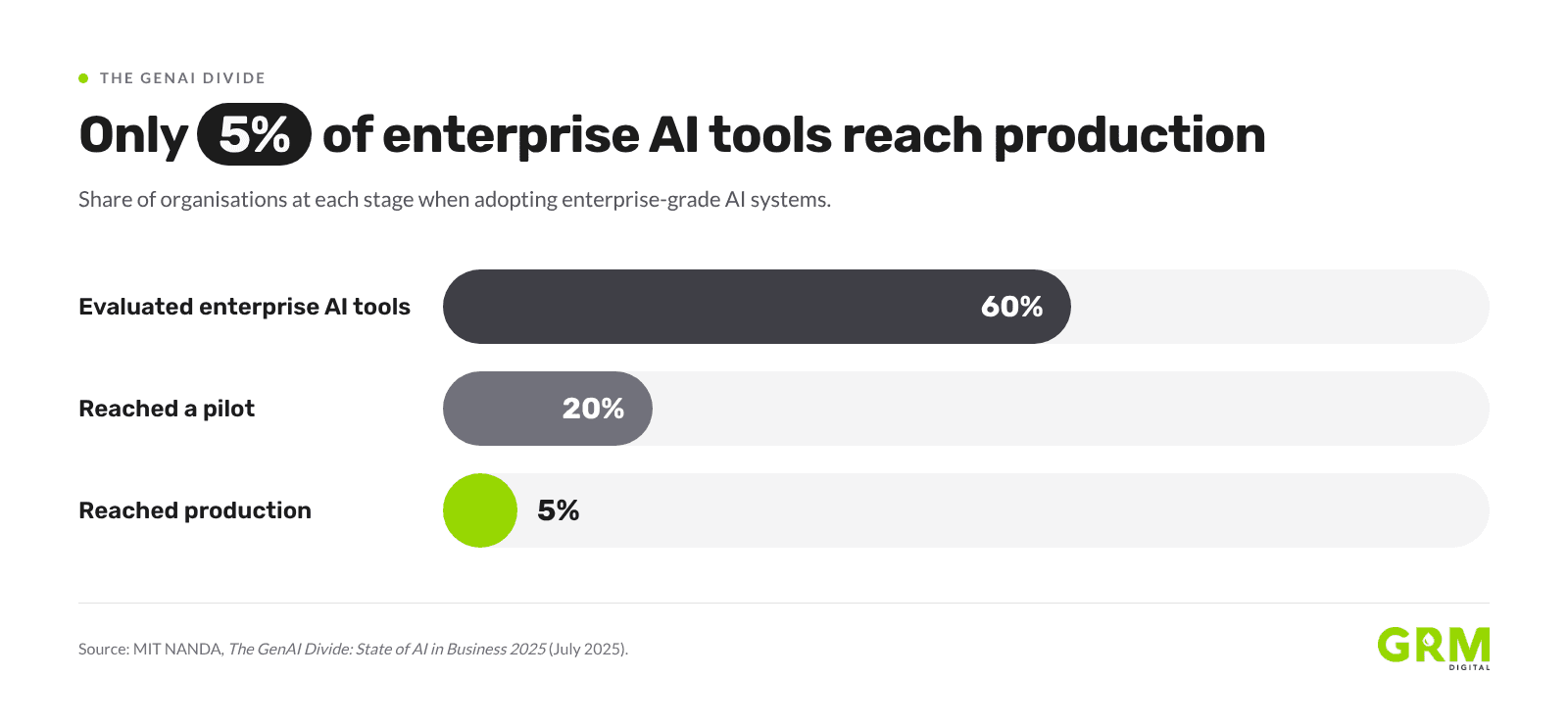
Enterprise AI stalls before it delivers. 60% of organisations evaluated enterprise-grade AI systems, but only 20% reached a pilot and just 5% reached production. MIT puts the failures down to brittle workflows, a lack of contextual learning and poor fit with day-to-day operations.
Few industries have really changed. Only two of the sectors studied, technology and media, showed clear structural disruption. One manufacturing COO summed up the rest: the hype says everything has changed, but in practice nothing fundamental has shifted.
Budgets go to the wrong places. Sales and marketing attract around half of generative AI budgets because the results are easy to measure. Yet MIT found back-office areas such as finance, procurement and operations often deliver faster payback.
The researchers call the core problem the learning gap. Most AI deployments don't retain feedback, adapt to context or improve over time. They are dropped into a process, used for a while, then quietly abandoned.
It's worth noting the report is a preliminary study, and some commentators have questioned how its 95% figure has been reported. But its central finding, that results depend on how AI is implemented rather than which tool is bought, matches what we see with clients every day.
Why bolt-on AI fails
Most AI projects fail because they ask a narrow question: which task can we speed up with AI? The organisations seeing returns ask a broader one: if we were designing this process today, knowing what AI can do, what would it look like?
The first question leads to bolt-on AI. A chatbot is added to the website. A writing assistant is rolled out to the marketing team. A summarisation tool is plugged into the CRM. Each might save a few minutes, but the process around it stays the same. The data is still siloed, the approvals still sit in someone's inbox and the hand-offs still break.
MIT's research shows exactly where this leads. One corporate lawyer in the study described a $50,000 contract tool that produced rigid summaries, so she went back to a $20-a-month chatbot. The expensive tool hadn't failed technically. It had simply been dropped into a workflow it didn't fit.
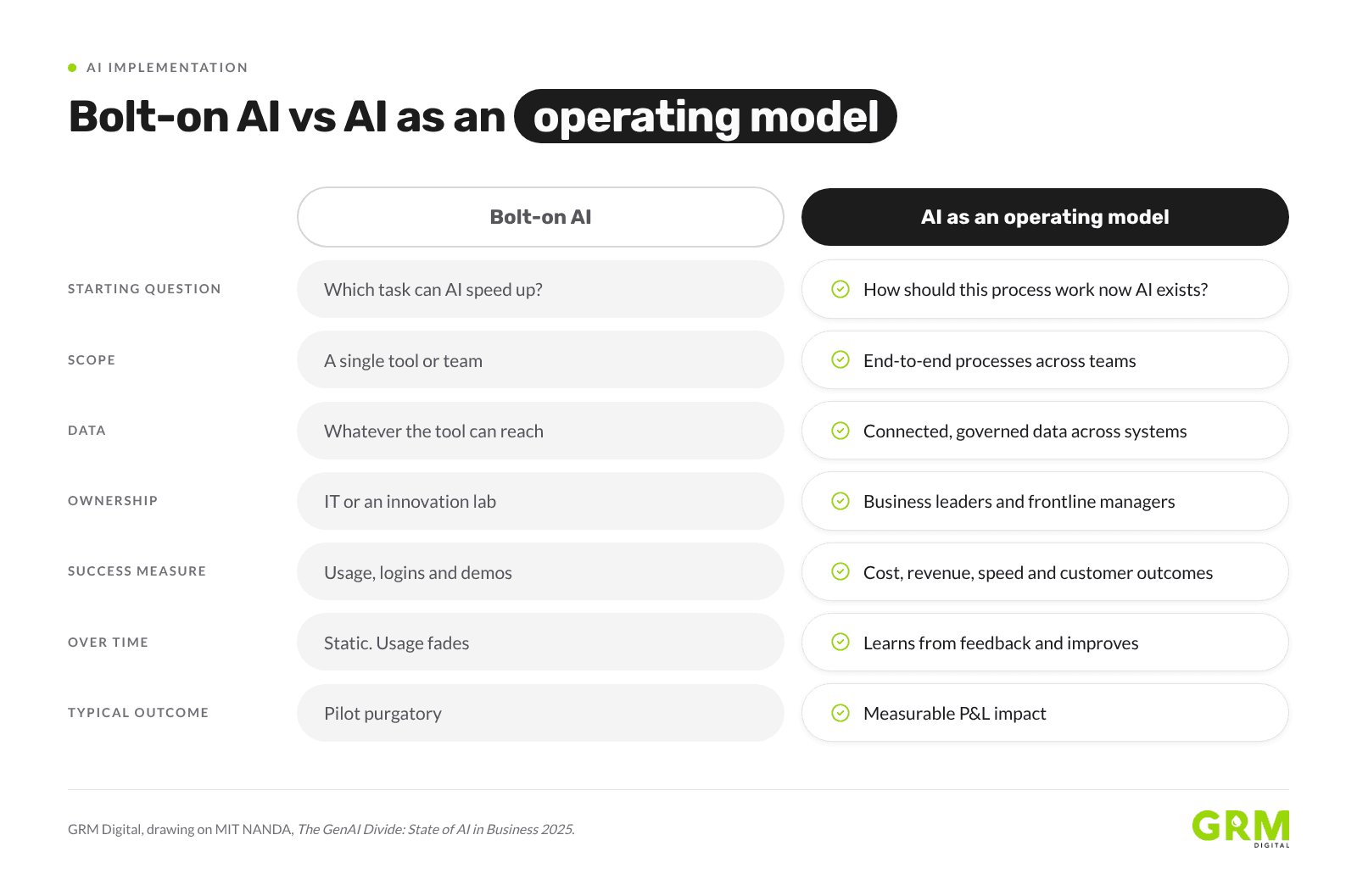
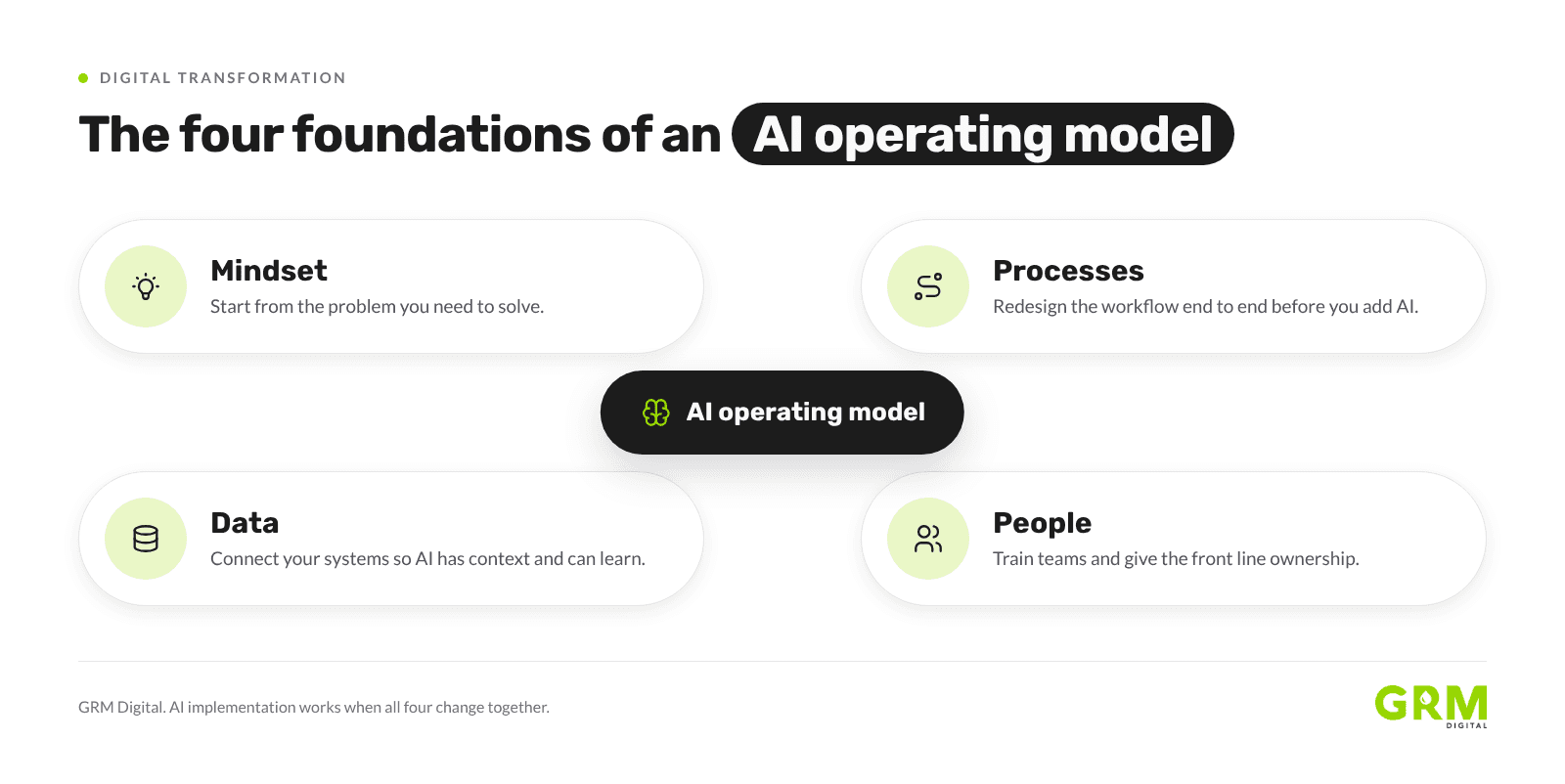
An operating model is the way an organisation combines people, processes, data and technology to deliver value. Treating AI as part of that model means changing all four, not just adding a fifth.
AI implementation is digital transformation
Successful AI implementation is a digital transformation project in everything but name. It touches the same four things every transformation does, and it fails for the same reasons when any of them is ignored.
1. Mindset: from tasks to problems
The biggest shift is in how people look at their work. Bolt-on thinking sees a list of tasks to automate. Transformation thinking sees problems to solve: why does onboarding a customer take three weeks? Why do sales and service teams hold different versions of the truth? AI becomes one of several ways to answer those questions, alongside process redesign, better data and better tools.
This is a cultural change, and it has to be led from the top. MIT found that the strongest deployments often started with frontline "power users" who already understood what AI could do, backed by executives who held the work to account.
2. Processes: redesign before you automate
Automating a broken process just produces bad results faster. Before adding AI, map the process end to end. Remove steps that add no value, fix the hand-offs and decide where human judgement is essential. Then decide where AI fits.
3. Data: the foundation AI learns from
MIT's learning gap is largely a data problem. AI can only adapt to your business if it can see your business: your customer records, your content, your workflows and the feedback from each interaction. If that data is scattered across disconnected systems, no AI tool will close the gap.
4. People: adoption is the real measure
MIT's survey found the top barrier to scaling AI was unwillingness to adopt new tools. Training, clear guardrails and visible early wins matter as much as the technology itself. People need to understand not just how to use a tool, but why the way they work is changing.
At GRM Digital, we describe this as digital evolution rather than a one-off transformation. AI changes quickly, and so will the way you use it. An operating model that expects continuous improvement will keep delivering value long after a one-off project has gone stale.
How to implement AI and join the 5%
The organisations on the right side of MIT's divide share a set of habits. Here is how to put them into practice.
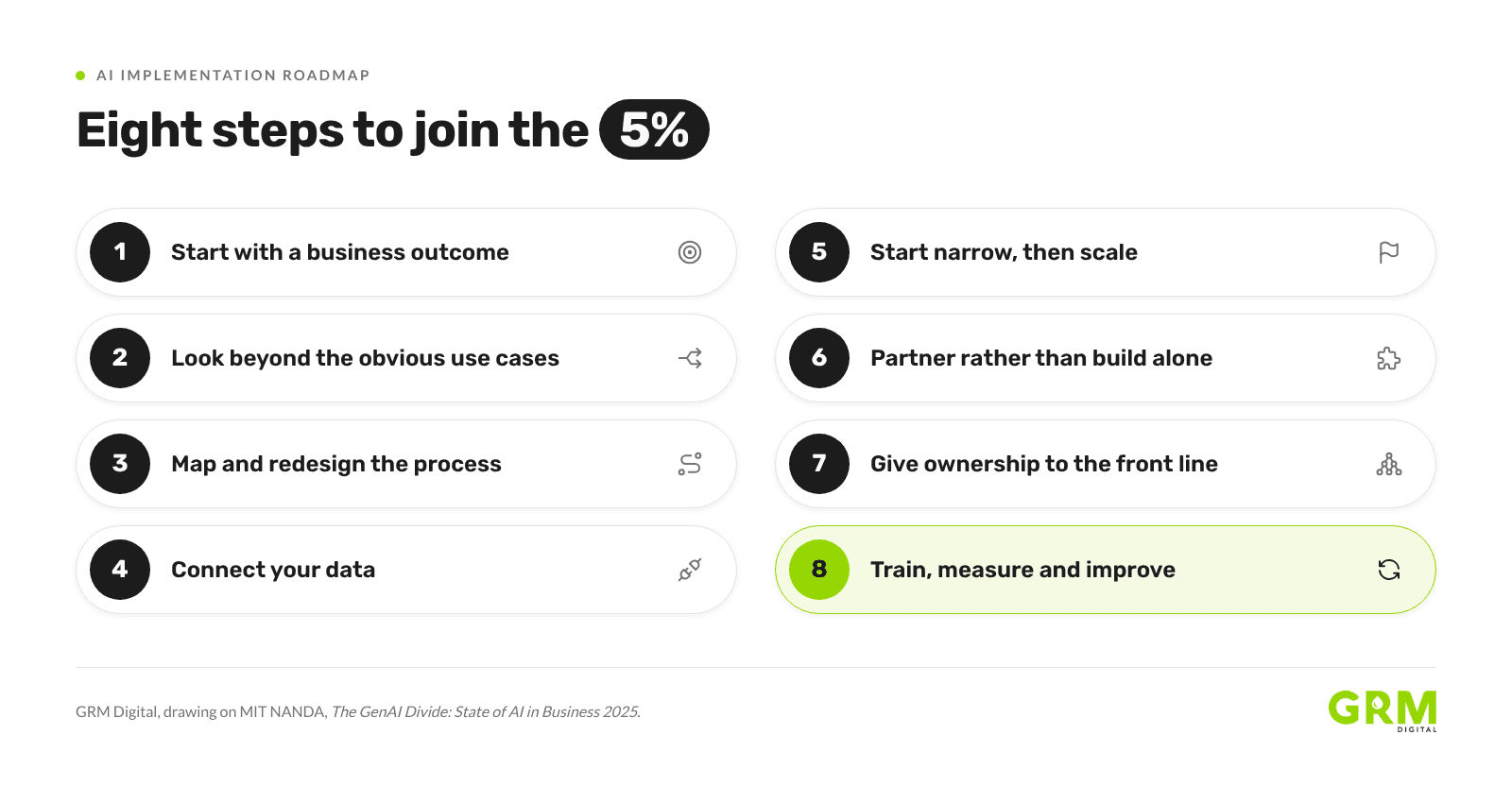
- Start with a business outcome, not a tool. Pick a problem with a clear cost or revenue impact, such as slow lead qualification, high support volumes or manual document processing. Agree how you will measure success before you choose any technology.
- Look beyond the obvious use cases. Sales and marketing are tempting because results are visible. MIT found some of the biggest savings in back-office work, including cutting outsourced processing costs by $2–10 million a year.
- Map and redesign the process. Understand how the work really flows today, where it breaks and where people add judgement. Redesign it with AI in mind rather than layering AI on top.
- Connect your data. Integrate the CRM, CMS and operational systems the process depends on, so AI has the context it needs and can learn from outcomes.
- Start narrow, then scale. MIT found the most successful tools landed small, visible wins in a single workflow before expanding. Mid-market firms that worked this way moved from pilot to full rollout in around 90 days.
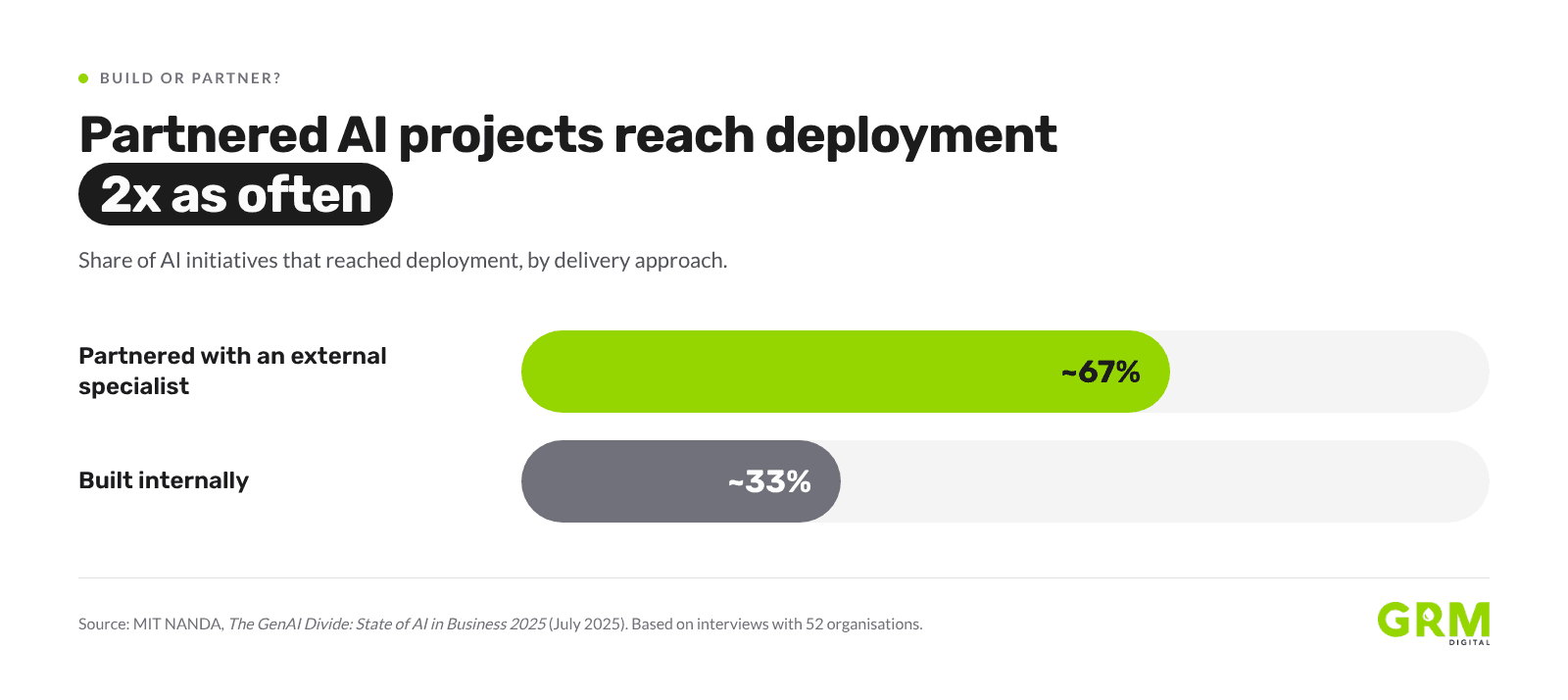
- Partner rather than build alone. In MIT's sample, AI projects delivered with external partners reached deployment about twice as often as internal builds.
- Give ownership to the people closest to the work. Let line managers surface problems and lead rollouts, with executive sponsorship and clear accountability.
- Train, measure and improve. Invest in training, track business KPIs rather than usage, and review regularly. An AI operating model is never finished.
How GRM Digital helps organisations cross the divide
MIT's research makes a strong case for partnership: organisations that worked with trusted partners who understood their workflows were far more likely to reach production. That is how we work. Since 2009, GRM Digital has helped complex organisations connect their people, processes and technology, and AI is now a natural part of that work.
- Digital strategy and transformation. We start with your commercial goals, not a tool. Our interactive transformation workshops, tech stack audits and digital roadmaps identify where AI will have real impact and set clear KPIs to measure it.
- AI services. From strategy and Microsoft Copilot set-up to workflow automation and AI-powered support tools, we help you use AI responsibly and integrate it with the systems you already rely on.
- Data. We build the tracking, monitoring and analysis that give AI the context it needs and give you the evidence that it is working.
- CRM and systems integration. We connect your CRM, website, portals and back-office systems so data flows where it is needed, closing the gaps that cause bolt-on AI to fail.
- UX design and user portals. We design AI-enabled experiences around how your customers, members and staff actually work.
- Support and training. Our onboarding, workshops and ongoing support sessions help your teams adopt new tools with confidence, so adoption doesn't stall after launch.
For more on the wider picture, read our ultimate guide to digital transformation.
Joining the 5%
The gap between the 5% and the 95% is not about access to better AI. Everyone has access to the same models. The difference is whether AI is treated as a bolt-on to old ways of working, or as a reason to rethink how the organisation operates.
That means starting with business problems, redesigning processes, connecting data, bringing people with you and improving continuously. It is digital transformation, with AI at its heart.
If your AI pilots have stalled, or you want to get your AI implementation right from the start, we can help. Get in touch with our team to book a digital transformation workshop and find out where AI can make a measurable difference to your business.
Frequently asked questions
Why do most AI projects fail?
MIT's research found most AI projects fail because of how they are implemented, not because of the technology. Tools are added to existing processes without redesigning them, they don't learn from feedback, and they don't connect to the data and systems people rely on.
What is the GenAI Divide?
The GenAI Divide is MIT's term for the gap between the 5% of organisations extracting real value from generative AI and the 95% seeing no measurable return on profit and loss. You can read the full MIT report here.
What is an AI operating model?
An AI operating model is the way an organisation combines people, processes, data and technology so that AI is built into how work gets done, rather than added to individual tasks.
How is AI implementation related to digital transformation?
Successful AI implementation changes processes, data, culture and technology together, which is what digital transformation means. Treating AI as a standalone tool is the most common reason it fails to deliver.
Where should a business start with AI implementation?
Start with one business problem that has a clear, measurable cost or revenue impact. Redesign that process, connect the data it needs, prove the value in a narrow area, then scale.